23 mins
•01. March 2026
Escalation of Cyber Sabotage |
What Happened?
On the morning and afternoon of December 29, 2025, a single threat actor launched coordinated attacks on several critical infrastructure facilities across Poland. These attacks impacted at least 30 wind and solar farms, a private manufacturing company, and a large combined heat and power plant supplying heat to nearly 500,000 customers.
The main objective was cyber sabotage: disabling OT field devices to disrupt telecontrol and protection functions, and (in other victim environments) wiping IT systems to slow response recovery. The attacks impacted traditional information technology (IT) and operational technology (OT) systems, representing a significant escalation in cyber sabotage. The attackers succeeded in disrupting communications and remote control between wind farms and distribution system operators (DSOs). At the combined heat and power plant and the manufacturing company, the attackers used sophisticated "wiper" malware designed to permanently delete files and render systems inoperable.
Loss of Telecontrol & Protection Functions | What Are the Consequences?
The consequences of these attacks are serious, ranging from operational failures to potential threats to public safety. Although power generation at the renewable energy plants was not immediately shut down, damage to the RTUs disabled remote control and monitoring of the facilities, meaning that operators could have been unable to control these decentralized power generation facilities for a time. Especially in critical grid situations, operators must be able to remotely curtail, adjust setpoints, or disconnect such plants quickly.
CERT also observed destructive actions against Hitachi Relion 650 protection and control relays (IEDs) in two cases . The attacker used File Transfer Protocol (FTP) and a built-in account with default credentials to delete essential operating files, causing the device to shut down and preventing it from restarting. Since protection relays detect faults and trip the breaker to safeguard equipment, disabling them eliminates a vital safety measure. If a protection relay is disabled when a fault occurs in a protected power line, transformer, or generator, the system may fail to promptly isolate the fault, which increases the risk of equipment damage and wider outages.
It was possible to disconnect the 30 attacked plants from the power grid. In the case of the combined heat and power plant, the sabotage targeted systems that were used during a period of high heating demand due to sub-zero temperatures. The irreversible destruction of data on workstations and servers could lead to long-term outages and massive costs for restoring the infrastructure. In addition, the theft of sensitive technical information related to SCADA systems and the modernization of OT networks could provide attackers with the information they need to carry out even more damaging attacks in the future.
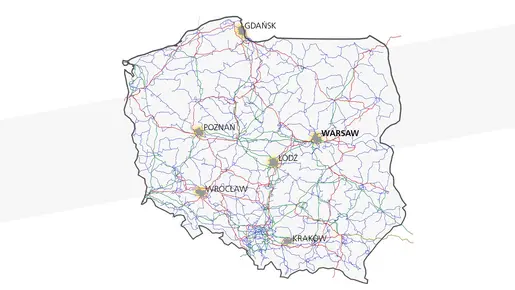
Polish Power Grid
Source: Openstreetmaps and ENTSO-E
Inadequate Password Hygiene |
How Did the Attackers Gain Access?
In almost all cases, the primary entry point for attackers was the exploitation of perimeter edge devices, particularly FortiGate firewalls and VPN concentrators. In renewable energy parks, these devices were exposed to the internet and lacked multi-factor authentication (MFA) in their authentication methods. Some of these devices had historical vulnerabilities, including remote code execution flaws that remained unpatched for extended periods.
A recurring problem was the use of default credentials and poor password management. Many OT systems were configured with factory default accounts, such as "Default."
In the manufacturing sector, an attacker obtained a device's configuration after it was made public in an online criminal forum. Additionally, the industry practice of reusing the same passwords for multiple facilities enabled the attacker to move from one compromised website to many others.
Destruction of OT and IT |
What Happened Next?
After gaining access to the networks, the attackers methodically conducted reconnaissance and persistence before ultimately destroying them.
How can the Damage of Such
Cyber Attacks Be Reduced?
It is difficult to protect yourself from an attack. However, you can reduce the impact of such attacks by using common security measures.
Enhanced Resilience for Greater Protection
To strengthen the resilience of OT in the energy sector, we recommend the following measures :
Interested in a Deeper Technical Breakdown of the Cyber Attack?
How detectable was the Polish grid attack really? Our whitepaper “OT IDS Detection of the 2025 Polish Grid Cyber Attack: A Technical Assessment” provides a detailed analysis of the documented attack chain—and shows which attacker activities would have been visible and detectable within an OT network.
Based on incident data, vendor advisories, and established OT security principles, it offers practical insights into how intrusion detection can help uncover similar threats earlier.
Download the whitepaper below and explore the findings.
Did You Know?
We provide cybersecurity consulting and expert-led trainings for IT and OT.