

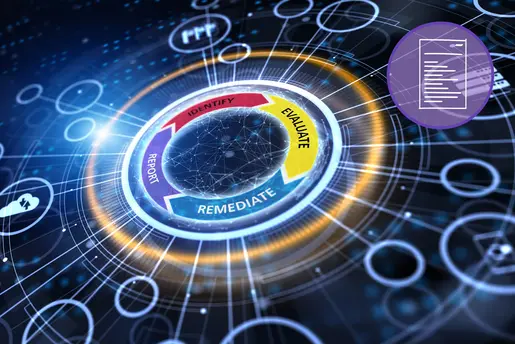
Your operational technology (OT) will thank you: A proper OT vulnerability management reveals vulnerabilities in your OT assets and OT environments as a whole, so you can implement protective measures, such as continuous IDS monitoring. This allows you to respond immediately to unauthorized activity and quickly restore normalcy through targeted remediation.
The more detailed the information about your assets, the easier it is to detect and prioritize events and alarms.
Do You
Know Your
Vulnerabilities?
We can assess your security risks. You will gain:
- Insight into all cybersecurity and functional aspects
- Identification of attack surfaces and vulnerabilities
- Detection of functional problems in the network and automation system
- Asset inventory for full visibility of OT components
Continuous OT Vulnerability Management
Gain visibility into vulnerabilities across OT assets, devices, and software – with security insights tailored to industrial environments.
OMICRON Threat Intelligence
Stay Informed & Make the
Right Decision
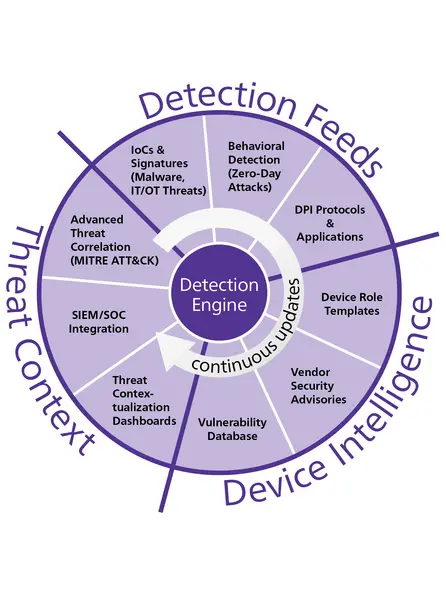
OMICRON’s Threat Intelligence (OTI) delivers updates to protect IT and OT networks from evolving cyber threats. These include:
✔️ Updated detection rules (IOCs), including Suricata signatures for malicious network traffic
✔️ Enhanced anomaly detection
✔️ Deep Packet Inspection (DPI)
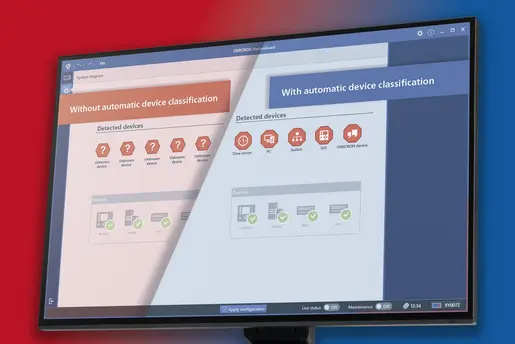
✔️ Device role template updates
✔️ Advanced threat correlation
✔️ SIEM/SOC integrations
✔️ Threat contextualization for dashboards
✔️ An up-to-date OT vulnerability database
OTI is focused on detection engineering to always keep your assets safe and you informed.
User Interface for Powerful
Vulnerability Management
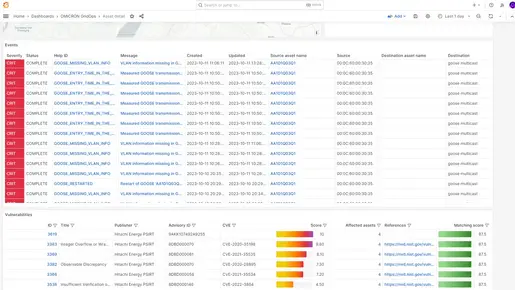
Detect weak points immediately
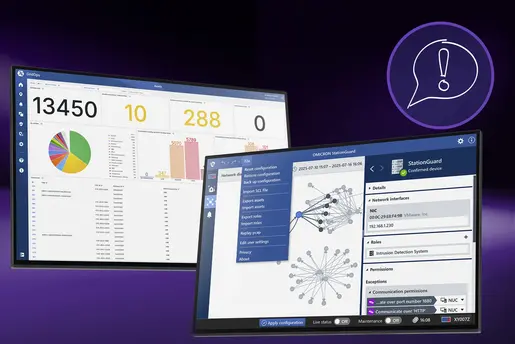
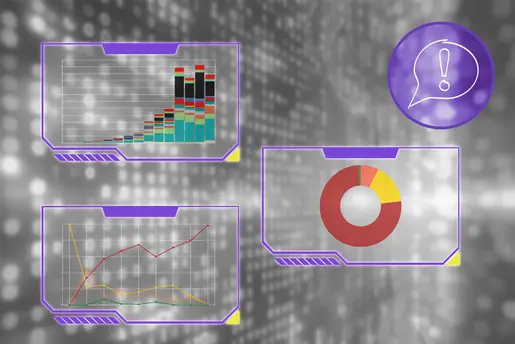
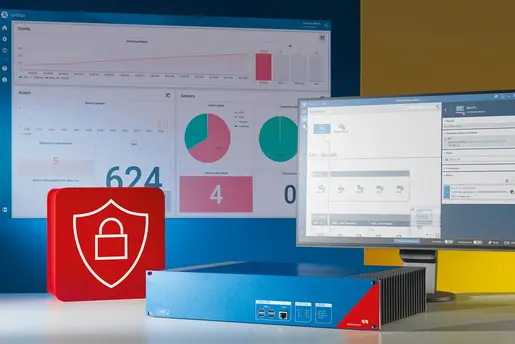
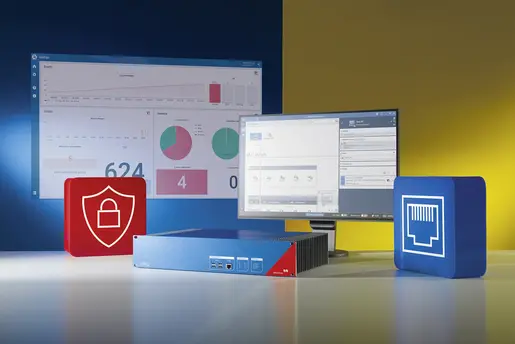
Our vulnerability dashboard lets you instantly identify vulnerabilities and their threat level. It provides continuous information about potential threats.
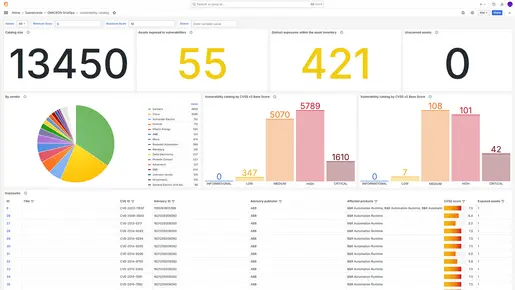
Intelligent scanning for OT vulnerabilities
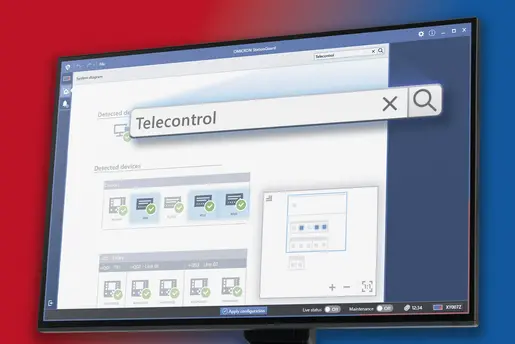
CVE (Common Vulnerability Exposure) analysis made easy: Use our vulnerability database to quickly determine which systems a specific CVE affects and which security advisories are relevant to you.
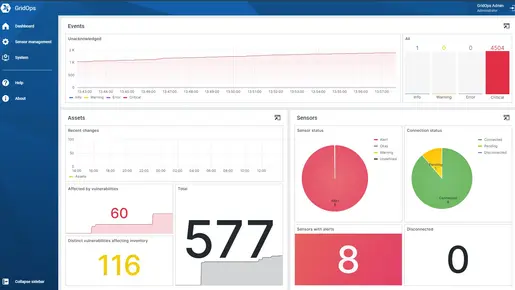
Visibility for all stakeholders
Generate overviews for reports with relevant information for management, suppliers, and auditors to prioritize risks. Visualize the cyber risk to your energy network with our help. Our visibility improves your understanding of your security posture.
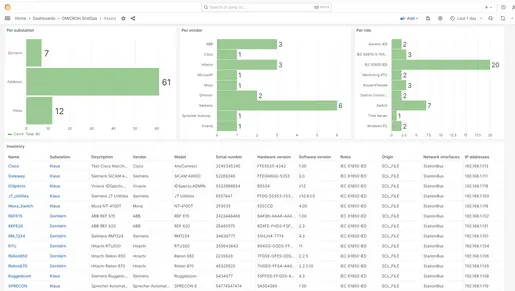
Supported by a precise equipment inventory
Our StationGuard solution compiles an asset inventory with detailed information from multiple sources to provide the best possible foundation for vulnerability management.
Frequently Asked Questions
What are 5 top vulnerabilities in OT environments?
- Critical SCADA Vulnerabilities: Flaws in systems like SICAM SCADA can allow unauthorized individuals to gain administrator rights on OT systems.
- Undocumented or Unauthorized Devices: Assets present in the network that are not tracked in the official inventory.
- Security/Operational Clashes: Ideal security requirements, such as network encryption, that are incompatible with the low-latency needs of real-time protocols like IEC 61850.
- Hardware-Level Weaknesses: Vulnerabilities inherent in the physical hardware devices that require specialized security engineering to mitigate.
Configuration and Communication Errors: Misconfigurations and functional errors that can be exploited or cause operational instability.
What are the top 5 types of cybersecurity threats?
Cyber threats in power systems refer to digital vulnerabilities that can result in catastrophic physical consequences for critical infrastructure, necessitating specialized intrusion detection and early-stage risk assessments to bridge the critical knowledge gap between IT security and operational technology. The most significant threats facing modern OT networks include:
- Internet-Connected OT Devices: Operational technology connected to external networks presents an alarming and often overlooked entry point for attackers.
- Attacks on Firewalls: As the primary line of defense, firewalls are high-value targets for attackers seeking to penetrate critical infrastructure.
- Unauthorized Network Access: The lack of network access control (NAC/802.1x) allows hackers to physically plug into Ethernet switches in substations and control centers.
- OS-Specific Dangers: The presence of Windows and Linux devices within OT networks introduces traditional IT vulnerabilities into specialized environments.
Evolving Malware and Signatures: Rapidly changing attack patterns and Indicators of Compromise (IoCs) require continuous behavioral detection to identify.
What are the initial steps of a good vulnerability management?
In general, when considering the key factors of setting up an effective vulnerability management in practice the following five steps ought to be considered:
- Up to Date Asset Inventory: Maintain an accurate and comprehensive list of all assets currently deployed in the environment.
- Update the Database: Ensure the central vulnerability database (such as GridOps) is updated with the latest threat information.
- Vulnerability Matching: Map the collected advisories to the real OT components identified in the inventory to see which assets are actually at risk.
- Perform Risk Assessment: Evaluate the identified vulnerabilities within the context of the specific operational environment to prioritize remediation and determine necessary compensating controls.
What challenges do engineers face when encrypting IEC 61850 networks?
IEC 61850 networks are "real-time networks" used by fast-acting protection devices. Implementing encryption on these networks is often not advisable because it can increase latency and cause delays that interfere with the speed required for electrical protection. This creates a conflict between security standards like IEC 62443, which may mandate encryption, and the operational reality of the grid. Engineers must often document these instances as risks and implement compensating controls, such as strict access policies and monitoring via an Intrusion Detection System (IDS).
What’s the difference between screening security advisories or using actionable OT intelligence?
Standard security advisories (like CVEs) provide technical information about a weakness but lack the operational context of a specific facility. Actionable OT intelligence, such as OMICRON Threat Intelligence (OTI), bridges this gap by mapping manufacturer security advisories directly to the actual assets present in the network. This ensures that security teams only focus on vulnerabilities that truly exist in their environment, which dramatically reduces "patching effort" and false alarms.
If you are interested in this topic, take a look at our article: Security Advisories and How Security Staff Should Use Them
How can asset mapping prevent overlooking relevant threats?
A comprehensive OT asset inventory is a prerequisite for a meaningful vulnerability assessment. Reliable asset visibility allows organizations to detect undocumented or unauthorized devices that might otherwise be overlooked. By mapping vulnerability information to real OT components—such as protection devices, SCADA systems, and gateways—organizations can prioritize risks based on the actual criticality of the hardware rather than overestimating generic exposures.
How do IDS solutions avoid adding latency to protection networks?
Solutions like StationGuard are designed as "functional monitoring" tools that keep the operator in control of network traffic without disrupting real-time grid operations. By providing high-performance monitoring and detection that is for the energy sector, these systems identify cyberattacks and communication errors while ensuring the network maintains the deterministic behavior required for protection protocols.
Do you want to learn what our IDS StationGuard Sensor can do for you? Visit the product page: StationGuard: Innovative Cybersecurity for the Power Grid
Resources










































Contact Us!
We’re looking forward to helping you.
- Have a question?
- Need more information?
- Would you like to request a demo?