

How to Recognize Faults, Malfunctions, and Critical Events?
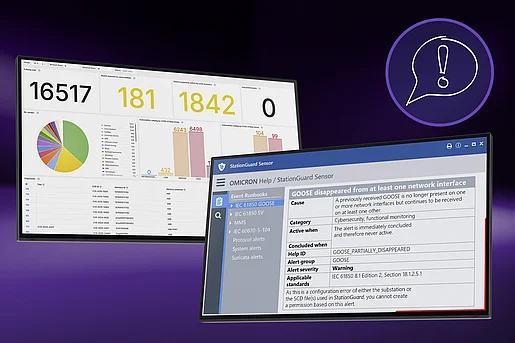
Easy answer: By detecting malfunctions and communication problems with automatic checking protocols for configuration errors, interoperability, and IED failures. Critical events are also logged automatically.
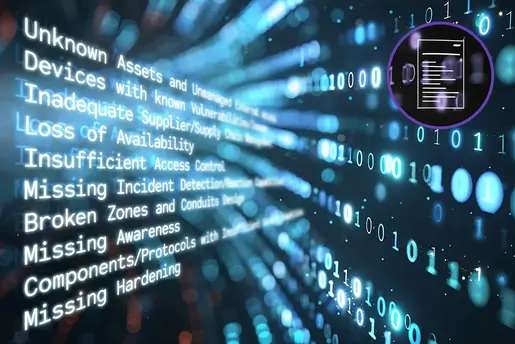
A selection of detectable issues:


“Functional monitoring is the cornerstone of reliability in complex systems, providing a real-time window into critical infrastructure. It detects malfunctions and functional problems in OT networks, creating opportunities for immediate response. ”
Effective Functional Monitoring - Notification, Diagnosis, Protection
Frequently Asked Questions
How does StationGuard supports "High Availability" without adding latency to real-time protection networks?
StationGuard Sensor is a non-intrusive network listener that captures traffic without being placed directly in the communication path. This is critical for IEC 61850 real-time networks, where traditional security measures like encryption are often avoided because they can cause latencies and delays that interfere with fast-acting protection devices. By observing traffic passively, it integrates into live environments without interrupting or slowing down protection and control functions.
How does functional monitoring bridge the "knowledge gap" between IT and electrical engineering?
StationGuard Sensor bridges this gap by providing operational context for security events. While electrical engineers may know how to program a relay but not the intricacies of IT protocols, functional monitoring translates network data into actionable alerts that relate to power system behavior. This supports collaboration between operational staff and centralized IT Security Operations Centers (SOCs) by creating a shared understanding of how network events affect grid stability.
How does StationGuard GridOps consolidate data from multiple heterogeneous sites?
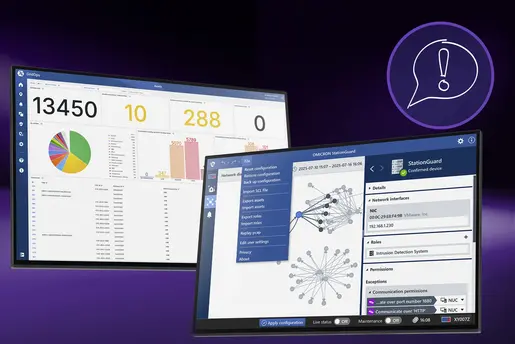
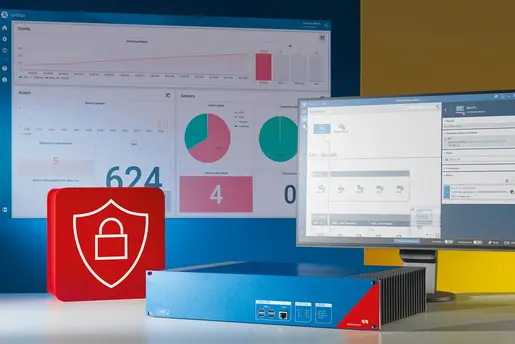
StationGuard GridOps acts as a centralized management platform that consolidates insights and telemetry from sensors deployed across distributed locations. It structures alerts and simplifies asset management, providing a unified view of all systems even when they consist of mixed generations of devices and different substation architectures.
What would be an example for configuration deviation?
A typical example would be a configuration change made during a maintenance window that inadvertently alters how a device interacts with the rest of the network. Other examples include communication timing deviations, unexpected device interactions following a firmware upgrade, or network performance fluctuations that differ from the established baseline.
What is the difference between ICS and OT?
While the sources often use these terms together (as OT/ICS), they represent slightly different focuses within the power industry. OT (Operational Technology) refers to the broader category of hardware and software used to monitor and control physical equipment in generation, transmission, and distribution. ICS (Industrial Control Systems) is a subset of OT that specifically includes the SCADA systems, substation automation components, and programmable controllers that manage these industrial processes.
Resources





















Contact Us!
We’re looking forward to helping you.
- Have a question?
- Need more information?
- Would you like to request a demo?